A Seedfolk draft note on turning the first MVP route into a focused playtest: curiosity, species reveal, CropDex progress, requests, rewards, persistence, and the honest metric of whether a player wants to plant one more seed.
I have been moving Seedfolk into its first real playtesting shape, which is a funny emotional milestone for a game.
When a system is still mostly private, it can survive on intention. I know what a Mystery Seed means. I know why the CropDex matters. I know which rough edge is temporary and which one is a design smell. I know that a placeholder button is standing in for a better thought.
A new player does not get any of that mercy.
They arrive with the screen, the first prompt, the seed in their inventory, and whatever the game manages to teach before confusion takes over. That is what these initial playtesting experiments are really about: not whether the whole dream is finished, but whether the first promise can introduce itself.
Mystery Seed -> species reveal -> CropDex entry -> harvest -> request -> reward -> another seedThat loop is small on purpose. Seedfolk has a much larger future in it: genetics, preservation, crossbreeding, mutation, better field tools, richer requests, deeper plant families. But the first route has one job.
It needs to make the player wonder what the seed will become, understand what changed when it reveals itself, and feel enough pull to plant again.
The playtest route is less a feature checklist and more a small question machine: what does the player notice, understand, and choose to do next?
This is not a bug bash yet
Section titled “This is not a bug bash yet”The first helpful decision was deciding what this pass is not.
It is not a full bug bash.
It is not a final art review.
It is not a balance pass.
It is not the moment to ask whether someone understands every future Seedfolk system.
That restraint matters because early playtesting can become noisy fast. If the test asks too many questions, every answer feels important and nothing becomes actionable. A rough placeholder icon, a missing animation, a mistuned timer, an unclear prompt, and an out-of-scope genetics idea all land in the same pile.
For this first route, I want the pile to be smaller.
The experiment is focused on five questions:
- Does planting an unidentified seed create curiosity?
- Does the species reveal clearly explain what just happened?
- Do CropDex progress and requests give the player a reason to continue?
- Does the player voluntarily start another planting loop?
- Do Mystery Seeds read as sealed discoveries rather than generic inventory?
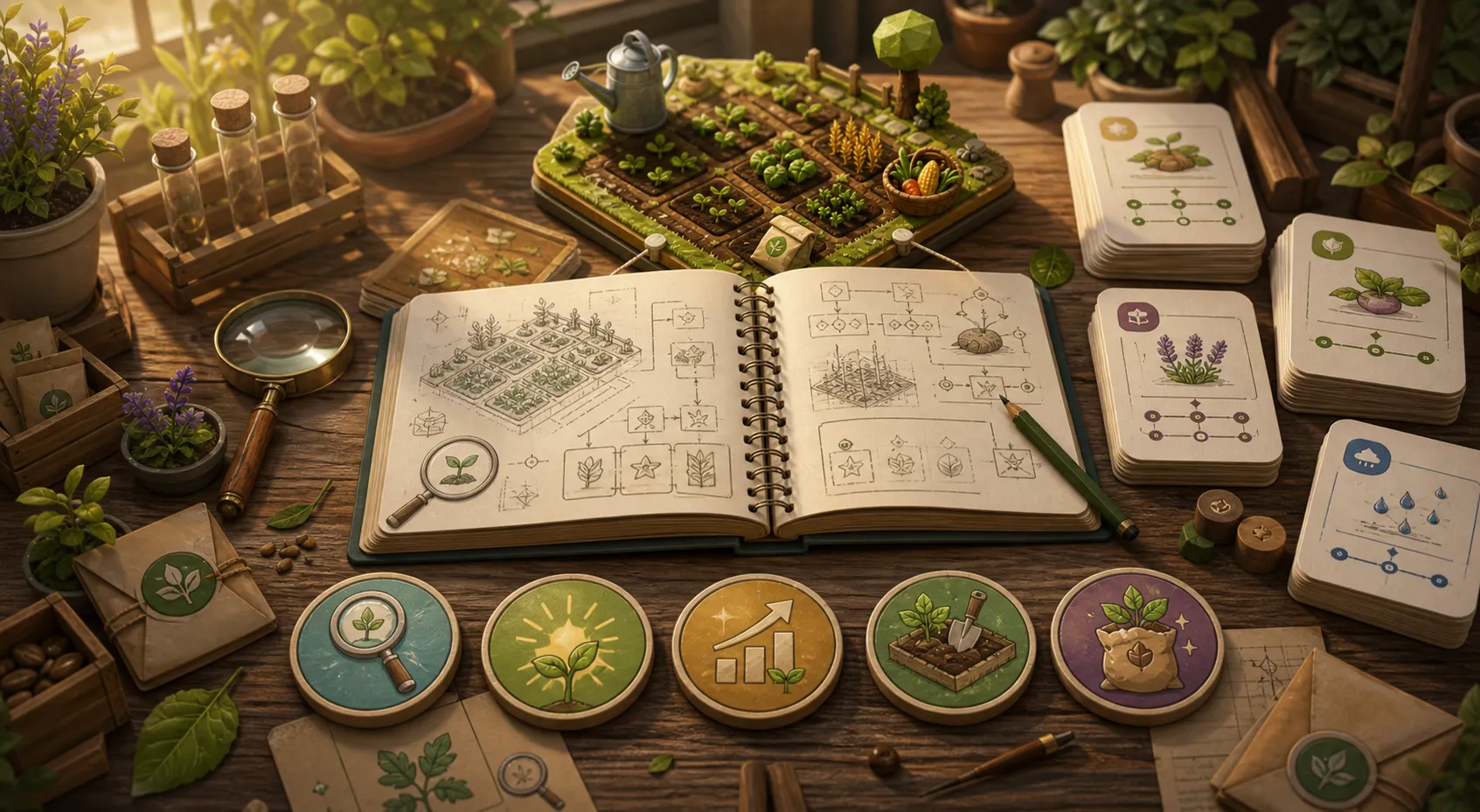
The first playtest is not trying to prove the whole game. It is listening for the few signals that tell me whether the first loop is teaching itself.
Those questions are useful because they are not asking whether Seedfolk is impressive. They are asking whether Seedfolk is legible.
That is a different kind of standard, and honestly a better one for this stage.
The 15-minute route
Section titled “The 15-minute route”The current owner-test route is designed to fit in about 15 minutes, with a few minutes afterward for notes. That is short enough to run repeatedly, but long enough to see whether the first loop has a beginning, middle, and next step.
The pass moves through a simple path:
- Load the farm and watch how the first screen orients the player.
- Select and plant a Mystery Seed without using implementation knowledge.
- Wait for the species reveal and record whether it reads as discovery.
- Check whether CropDex progress feels permanent and findable.
- Harvest the crop and understand what changed in inventory.
- Inspect a starter request and claim a reward when available.
- Pause and see what the player chooses without being told.
- Reload the page and check whether progress returns coherently.
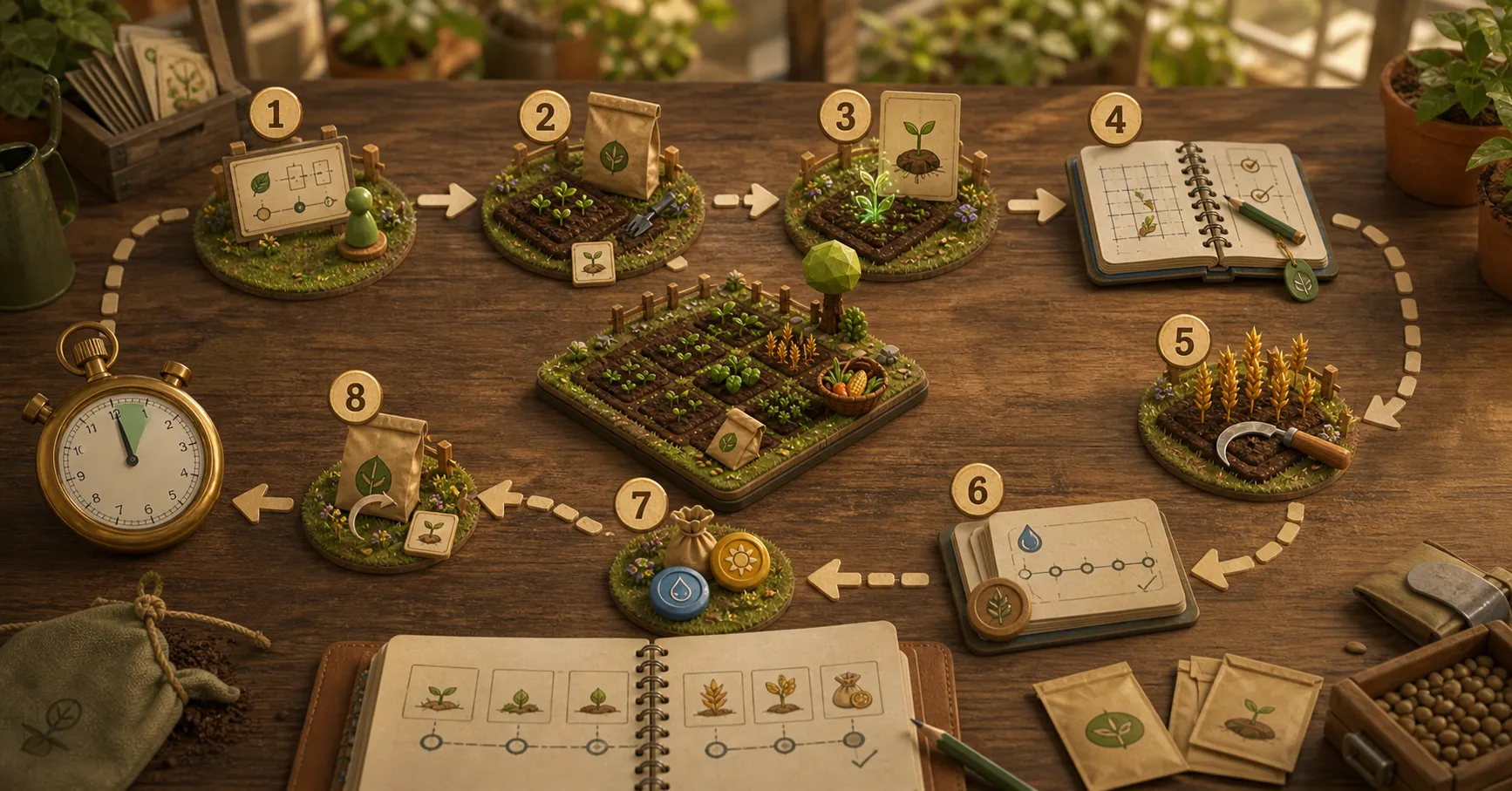
The route is deliberately narrow: it follows the first discovery loop until the player either asks for the next seed or the game loses them.
I have also been shaping this thinking into an Indie Game Playtest Report Kit, with a Ko-fi version for people who prefer that storefront. The kit is built around the same idea: make the playtest narrow enough that the notes come back useful.
That last step is easy to underrate. Persistence is not glamorous, but it is part of trust. If a discovery repeats strangely after reload, if a reward duplicates, or if the tutorial forgets what just happened, the game starts feeling less like a garden and more like a rehearsal.
I want the early route to survive that little reload test because Seedfolk’s long-term rhythm depends on time, return, and continuity.
Curiosity is the first mechanic
Section titled “Curiosity is the first mechanic”The most important object in the first pass is not a crop. It is the player’s question.
What is this seed?
That question has to exist before the reveal can matter. If a Mystery Seed feels like a normal commodity stack, the reveal becomes a timer event. If it feels like a sealed specimen, an unopened field note, or a small botanical question, the reveal has somewhere to land.
So the test watches for surprisingly human signals:
- Does the player notice that the seed is unknown?
- Do they ask what it might become?
- Does the UI accidentally spoil the species too early?
- Does the planting prompt reinforce mystery, or does it flatten the seed into a generic item?
- Does the world state after planting still preserve the question?
This is where playtesting starts to feel less like QA and more like listening.
The implementation can be technically correct and still teach the wrong mental model. A seed can plant successfully, a crop can grow on schedule, and the player can still come away thinking, “I clicked a thing and then another thing happened.”
The game has to do a little more than change state. It has to preserve anticipation.
Reveal has to be a moment
Section titled “Reveal has to be a moment”The species reveal is the first big handshake between system and player.
Seedfolk is not trying to hide information forever. It is trying to stage understanding. The player begins with an unknown seed, tends it, and then the game says, in some clear way: you have discovered what this is.
That reveal needs to avoid two traps.
The first trap is being too quiet. If the crop simply changes appearance while the player is looking elsewhere, the discovery can be missed. The system did the work, but the experience did not.
The second trap is being too loud or too crowded. If the reveal brings up too many future ideas at once, the player is no longer learning “this unknown seed is now known.” They are learning that Seedfolk has a lot of tabs.
The first reveal should teach one thing well.
You planted an unknown seed.
It became a known species.
That discovery now belongs to your record.
You can do something useful with it.
That is enough. Later systems can wait their turn.
Progress needs a place to land
Section titled “Progress needs a place to land”One of the useful things playtesting exposes is whether progress is visible in the right place.
Discovery cannot live only inside the domain model. It needs a surface. In the MVP route, that surface is the CropDex, or Field Journal language as the player-facing tone keeps settling into place.
The question is not only “did the record update?” It is:
- Did the player notice that the discovery became permanent?
- Could they find the new species entry?
- Did the entry explain enough without leaking post-MVP ideas?
- Did the record make the first reveal feel more meaningful?
The same is true for requests. A request board is not just a chore list. In this early route, it is a reason-giving surface. It tells the player why growing, discovering, and harvesting matter right now.
Good requests should feel like local purpose, not homework.
The starter route should let a player think, “Oh, this discovery helped me complete something, and that reward gives me a reason to keep going.” That is the tiny productive circuit I am trying to prove before layering on more elaborate systems.
Voluntary replant is the honest metric
Section titled “Voluntary replant is the honest metric”The cleanest signal in this first experiment is also the simplest:
Does the player plant another seed when nobody tells them to?
Not because the tutorial demanded it. Not because the script forced the next click. Not because the tester is being polite.
Because the previous loop created enough curiosity, clarity, and purpose that another seed feels like the natural next move.
That is the heartbeat I am looking for.
The numbers in a playtest rubric can help, but this moment is wonderfully hard to fake. If the player pauses after the first reward and chooses to inspect the CropDex, check a request, or plant another Mystery Seed, the game has started to generate its own next question.
If they stop and ask, “What am I supposed to do now?” then the work is not to add five more systems. The work is to make the first system speak more clearly.
Compressed time, honest time
Section titled “Compressed time, honest time”One practical playtesting trick has been using compressed crop timers while keeping the underlying time model honest.
For a 15-minute route, the first crops need to move fast enough that planting, reveal, harvest, request progress, and replanting can all be observed in one sitting. That does not mean the game should lie about time internally.
Seedfolk still needs real-world timestamp semantics because the eventual game depends on return rhythms, offline progression, persistence, and decisions that should not vanish just because the browser closed.
So the playtest profile can compress growth, while the core model still treats planted time, reveal time, ripe time, and reload behavior seriously.
That gives the best of both worlds:
- quick local testing for the first route
- repeatable owner passes
- readable wall-clock notes
- fewer “come back in three hours” blockers during development
- a persistence model that is not built on pretend time
This is one of those unglamorous engineering choices that protects the design. The player feels a simple loop. The code keeps the future rhythm possible.
What these experiments are already teaching me
Section titled “What these experiments are already teaching me”The early lesson is that playtesting is not just a way to find broken features. It is a way to find broken assumptions.
I can assume the first action is obvious.
The player can prove it is not.
I can assume the reveal reads as discovery.
The player can experience it as an ordinary growth stage.
I can assume the CropDex is the natural next surface.
The player can ignore it completely because nothing invited them there.
I can assume “Mystery Seed” carries the fantasy.
The player can read it as just another stack of inventory.
That is not discouraging. That is the gift of the process.
The whole point of these first experiments is to let the game become more honest while it is still small enough to change. The best playtest notes are not insults to the design. They are little lanterns pointed at the places where intention has not yet become experience.
The next pass
Section titled “The next pass”The next version of this work is straightforward:
- Run the route with fresh state.
- Record actual reveal and harvest timing.
- Watch the first 10 seconds carefully.
- Track whether CropDex and requests are opened voluntarily.
- Note every place where future systems appear too early.
- Reload and check that discovery, inventory, requests, rewards, and tutorial progress survive.
- Fix only the blockers that prevent the first loop from being judged.
That last sentence is the hard part. Early games invite overreaction. Every note sounds like a reason to build a new panel, add a new tutorial line, or drag a future mechanic into the present.
But the MVP does not need to explain the whole future of Seedfolk.
It needs to teach the first question well:
What will this seed become?
And then, with just enough clarity and warmth, it needs to help the player ask the next one.